Make Your Business Easier to Research in AI Search
Improve AI search visibility with clear service information, credible evidence, useful comparisons, and consistent details that help buyers evaluate your brand.
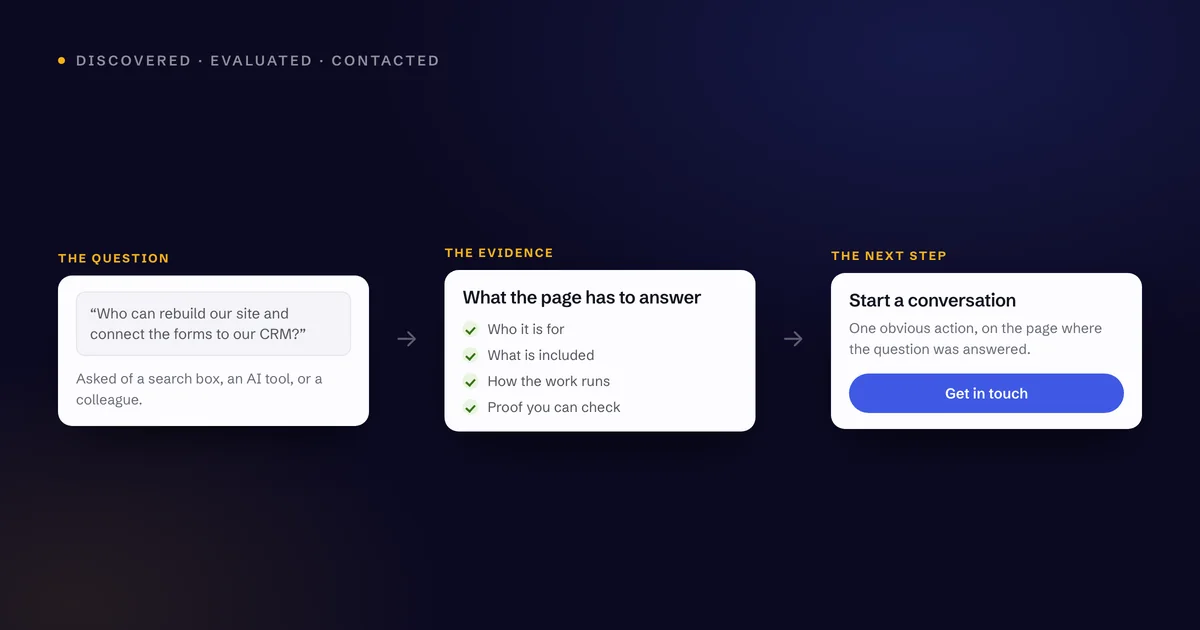
AI search optimization starts with a question I think every business should ask: if someone researched us today, would they find enough information to make a confident decision?
Not just a tagline. Not just a list of services.
Would they understand who we help, what we actually do, how we work, and why the claims on our website are believable?
When an AI search experience gathers information from several pages, those details become part of the material available for an answer. They also matter to the person who eventually visits your website.
That is where I would focus.
Separate getting discovered from getting chosen
These are two different jobs.
A useful page may help your business appear during initial research. The next question is whether the available information supports choosing you.
Imagine a business owner looking for help rebuilding a website and connecting forms to a CRM. A page that only says "beautiful websites" leaves half the problem unanswered.
A clearer page would explain the website work, the integration process, responsibilities, and what needs to be confirmed before a project starts.
You cannot control every recommendation. You can control whether your own explanation is complete.
Write pages around real buying situations
Start with the services and problems that matter to your customers.
For a digital marketing business, that could include redesigning an outdated website, improving lead capture, or helping a team use AI tools in its workflow.
Each page needs a distinct purpose. Describe the audience, the problem, the approach, the deliverables, and the next step.
Use a specific headline and natural language. Include the important topic in the title and introduction where it reads comfortably.
I would avoid copying every visible AI search query into a new page. One observed search is a clue, not a content strategy.
Ask whether the page would still help a customer who arrived through a referral.
Give your claims somewhere to land
If you say you work with complex marketing systems, explain the relevant capabilities.
If you claim a project improved performance, show the measurement period and what changed, provided you have permission to share the information.
If you mention an award or credential, make it verifiable.
This is also where clear author information, a useful About page, and consistent business details help a reader understand who is behind the content.
I would review the gaps between the promises on service pages and the evidence elsewhere on the site. Unsupported claims are an editing problem before they are a search problem, and they are the first thing online reputation management has to clean up.
Create comparisons that actually help
Comparison content can be useful when buyers are weighing legitimate options.
For example, an article comparing an AI website builder with a custom development approach could discuss editing flexibility, integrations, ongoing support, and the amount of internal time each option requires.
Explain the tradeoffs. Identify the situations where each approach makes sense.
If your business sells one of those options, disclose that relationship. Readers should understand the perspective behind the advice.
A page that awards your own company first place without meaningful criteria does very little to help someone evaluate the choice.
I would rather publish a comparison I could comfortably walk through on a sales call.
Build credibility beyond your own website
Keep business profiles and relevant directories accurate. Encourage honest customer feedback. Look for legitimate opportunities to contribute expertise to industry publications and communities.
Independent coverage can provide another perspective on your business, but a mention is not a guaranteed AI citation.
Be careful with paid placements. Make the commercial relationship clear and ensure sponsored links are handled appropriately. Google's spam guidance addresses paid links used to manipulate rankings. [6]
Paying for distribution does not make the resulting praise independent.
A press release also needs an actual announcement. Repeating promotional claims across syndicated pages is a weak substitute for evidence.
Test a small set of realistic questions
Choose several questions that reflect how your target customer evaluates a provider.
Review the answers, sources, and missing details across the tools your audience uses. Expect variation between runs and products.
Do not assume every model performs live research on every prompt. An answer without visible sources gives you less information about where its claims came from.
When you spot a gap, improve the most relevant page. Avoid rebuilding your entire content plan around one unusual response. Often the fix is internal linking rather than anything new.
Then track search visibility, identifiable referrals, and the quality of new inquiries alongside what prospects tell you.
My view is that the most useful AI search work makes your business easier to understand, compare, and verify.
Sources for this article
Want a second set of eyes on your website? Let's look at the gaps between getting discovered and earning the inquiry.
Start a conversation