Your Online Reputation Needs More Than a Five-Star Screenshot
Strengthen your online reputation with authentic reviews, useful customer stories, and a clear response process as buyers use AI tools to research businesses.
Online reputation management now includes a question many businesses did not used to ask: what happens when someone asks an AI tool whether we are worth hiring?
The answer may depend on the tool, the prompt, and the sources it finds. It may also be incomplete.
That makes accurate, accessible information about your business more valuable.
My approach would start with the same thing that supports a good sales conversation: real evidence from real customers, presented with enough context to mean something.
A folder full of five-star screenshots is a start. It is not the whole strategy.
Find out what a potential customer sees
Search your business name alongside words such as reviews, complaints, pricing, and alternatives.
Look at the results someone would actually encounter: review platforms, social posts, videos, business listings, and your own pages.
You can also test a few realistic questions in AI tools that offer web research. Record the answer and any cited sources. Treat that as a snapshot, not a permanent statement of what the system believes.
The useful question is where inaccurate or missing information comes from.
If your old service description still appears on a directory, fix it. If a credible customer concern keeps appearing, address the underlying problem.
Ask for specific, honest feedback
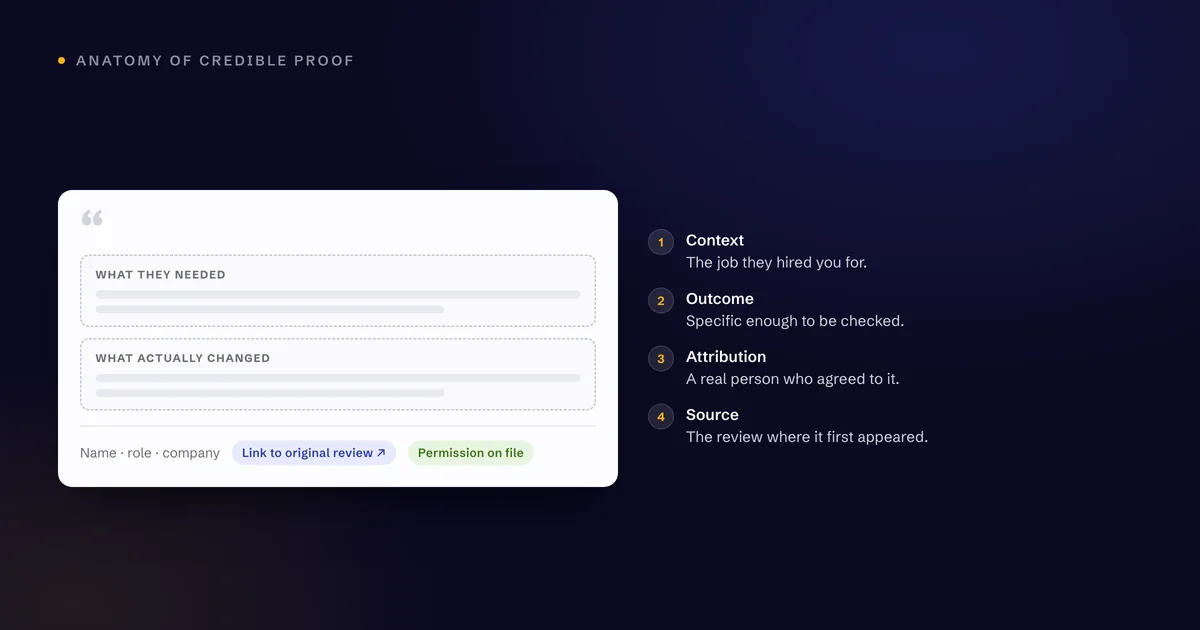
A testimonial that says "great company" feels good. A testimonial explaining what the customer needed, what you delivered, and how the experience went is more useful to a buyer.
Ask open questions.
What were you trying to accomplish? What helped during the project? What would you tell someone considering the same service?
Keep the customer's meaning intact. Get permission before republishing their words, name, image, or video, and respect the original platform's terms.
My standard would be simple: do not write a review for someone and present it as their independent opinion.
Build a useful home for customer proof
I would usually start with a testimonials or case studies section on the main website.
Organize the material around what a potential customer needs to evaluate. A small business owner considering a redesign may care about communication, content support, and whether the site is manageable after launch.
A larger organization may care about approval workflows, integrations, and coordination across teams.
Add that context where you have permission and accurate information. Link to the original review when possible. The same evidence does a second job on your service pages, where a claim and its proof should sit close together.
For video testimonials, provide an accurate transcript and captions. That makes the content easier to use when someone cannot listen or prefers to read.
Share the evidence without pretending it is independent
Adapt customer stories for the channels your audience already uses.
A short video excerpt may fit LinkedIn. A written story may work in an email. A relevant testimonial can support a service page.
Keep the source and meaning clear. Repeating one review in several places does not turn it into several independent endorsements.
I would be cautious about creating separate review domains and additional websites that summarize those domains. They add upkeep and can blur who is making the claim.
Google's spam policies also warn against doorway abuse, including sites or pages created to rank for similar queries and funnel visitors toward a destination. [6]
If you operate a separate branded review site for a real audience need, disclose ownership clearly and give it a useful purpose beyond occupying more search results.
Respond to questionable claims with evidence
If you find a review you believe is false, save the relevant details and use the platform's reporting process.
Keep any public response calm and specific. Avoid publishing private customer information or escalating a dispute through speculation.
When a claim comes from a genuine service problem, explain the resolution you can reasonably offer.
When a recurring factual misunderstanding appears, improve the information on your own website. A clear explanation of pricing, scope, or policies may help future readers evaluate the issue.
Nobody can promise to remove every negative result or control every AI answer.
Use testimonials to help people decide
Paid promotion can put a useful customer story in front of interested prospects. I would test it with a sensible budget, audience controls, and frequency limits.
Review tracking and consent requirements before adding advertising pixels. Then measure qualified inquiries and business outcomes.
The goal is to reassure someone with relevant proof, not follow them indefinitely with the same praise.
Also avoid assuming your own testimonials qualify your business for review stars in Google. Its review markup guidance restricts self-serving reviews for Organization and LocalBusiness. [7]
A strong reputation strategy makes accurate information easier to discover and backs it with a customer experience worth talking about. Done well, it also helps buyers evaluate your brand without having to take your word for anything.
Sources for this article
Want a second set of eyes on your website? Let's look at the gaps between getting discovered and earning the inquiry.
Start a conversation