Google Search Is Changing. Here Is Where I Would Focus.
Build a practical SEO plan for Google AI search. Focus on useful service pages, credible proof, clear next steps, and the business results that matter most.
Google AI search is changing how people research businesses, compare services, and decide what to do next.
That deserves attention. It does not mean every company needs to tear up its marketing plan.
My first question is still straightforward: when someone has the problem you solve, can they find a clear, credible reason to choose you?
The search experience may include a traditional result, an AI-generated explanation, or several follow-up questions. Your website needs to support that research and make the next step feel easy.
Here is where I would focus the work.
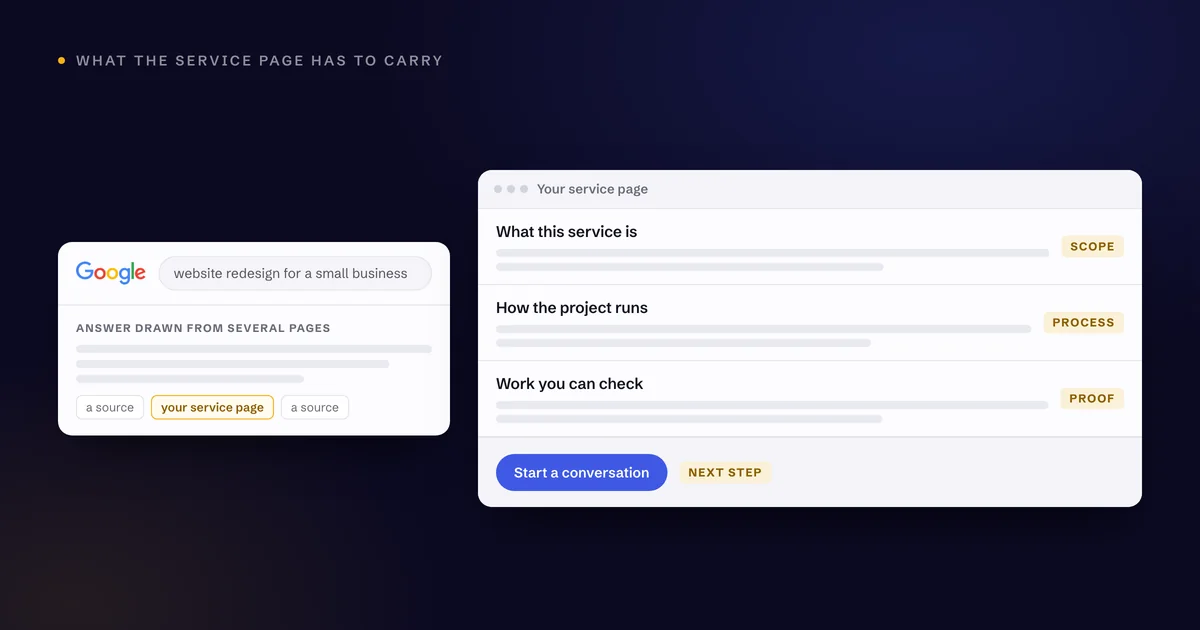
Make your service pages carry more weight
A surprising amount of marketing effort goes into articles while the actual service pages remain vague.
"We deliver innovative solutions" tells a potential customer very little. What do you do? Who is it for? What is included? What happens after someone contacts you?
I would start there.
For a website redesign service, explain the planning process, content responsibilities, likely project stages, and factors that affect cost. Show relevant work with permission. Address the questions that otherwise become back-and-forth emails.
That helps a buyer evaluate the business, regardless of how they arrived.
Answer the questions behind the search
People rarely make a significant purchase after reading one broad definition.
They compare approaches. They ask what could go wrong. They want to know whether a service fits their situation.
Build useful content around those decisions.
For example, a business considering a new website may need to understand whether its current platform can support future changes, who will manage updates, and how forms connect to the CRM.
Those are practical questions with business consequences. I would prioritize them over another general article explaining that websites are important.
Use the language customers use on calls. It is usually clearer than the language businesses put in their navigation menus.
Understand AI visibility without chasing a secret formula
Google explains that AI Mode and AI Overviews may use query fan-out, which involves related searches across subtopics and sources. That helps explain why a useful answer may draw on more than one page. [5]
For a business, my interpretation is simple: make the important facts easy to find and support. That is most of what AI search optimization amounts to in practice.
Publish clear service information, useful supporting articles, and credible evidence. Keep related pages connected.
I would not build a separate collection of awkwardly worded pages for every prompt an AI tool might generate. Search behavior changes, and thin variations do not make your website more useful.
Put proof close to the claim
If you say you understand a particular industry, show relevant work or explain a specific challenge you help address.
If you describe a process as simple, show the steps.
If you make a results claim, explain the context and use numbers you can verify. A percentage without a baseline or timeframe can create more questions than confidence.
Testimonials, case studies, author information, and detailed examples serve different purposes. Use the evidence that fits the statement, and give that customer proof somewhere sensible to live.
My preference is to make the buyer do less detective work.
Keep the technical foundation in place
Google's guidance says existing SEO practices apply to its AI features. Supporting pages need to be indexed and eligible for search snippets; there is no special AI schema required. [5]
I would check that important content is crawlable, readable, linked from relevant pages, and comfortable to use on a phone.
For an AI-built website, this deserves particular attention. A page can look finished while forms, page metadata, or crawlable content still need work.
The finished screen is only part of the finished website.
Measure business progress alongside visibility
A useful reporting view connects search performance with what visitors do next.
Track relevant impressions and clicks, but also form submissions, booked conversations, qualified leads, and opportunities where your systems support that connection.
Google reports traffic from its AI search features within the Search Console Web performance data. Treat broad organic changes carefully rather than assuming you can cleanly attribute them all to AI. [5]
Ask new prospects how they found you. Their answer can add context that an analytics report misses.
I would also test whether the contact process works. A broken form can erase the value of a perfectly good search visit.
Start with one manageable improvement
Choose one important service page. Improve the explanation, add relevant proof, and make the next step obvious.
Then update a supporting article that answers a real buyer question.
That gives you something concrete to publish, measure, and build on. It is a more useful starting point than chasing every new acronym.
Sources for this article
Want a second set of eyes on your website? Let's look at the gaps between getting discovered and earning the inquiry.
Start a conversation