Your Next SEO Win Might Already Be on Your Website
Find SEO opportunities in your existing content. Improve internal links, match search intent, and guide more website visitors toward becoming qualified leads.
Before I recommend another blog post, I want to know what is already sitting on the website.
That service page nobody has touched in a year. The article that still gets a few clicks every week. The helpful explanation buried three scrolls down a page. There may be something useful there, especially if those pieces cover related questions but never point readers toward each other.
Internal linking for SEO gives that content a clearer job. It helps people find the next useful answer and helps search engines understand the connections between your pages.
Here is how I would approach it.
Start with the business outcome
Pick a topic that connects to something you actually sell.
If you build websites, "website redesign for small businesses" probably deserves more attention than a broad article about the history of the internet. Both might attract visitors. Only one clearly connects to a service inquiry.
Ask yourself who is searching, what they need to know, and what would make them comfortable taking the next step.
Those answers matter more than squeezing the same phrase into every paragraph. A page can mention the right keyword repeatedly and still fail to answer the question behind it.
Find the pages you already have
A quick starting point is a Google search using the site operator:
site:example.com website redesign
Try a few related phrases, too. Exact wording can hide useful pages that discuss the same subject differently.
Treat this as a shortcut for finding content, not a complete inventory or an authority score. I would also check the website itself and Google Search Console to see which pages receive impressions for related searches.
Make a short list. Which page explains the service? Which answers an early research question? Which provides an example or addresses a concern?
You are looking for a useful path through the content.
Choose the page that deserves the visit
The first result Google shows is not automatically the best destination.
For a service-related search, the strongest target might be a service page with a clear scope, examples, process, and contact option. For an educational search, an article may be a better fit.
Read the page as if you were considering hiring the business. Does it answer the obvious questions? Does it explain who the service is for? Is there a sensible next step?
If the page is thin or confusing, fix that first. Sending more people toward an incomplete answer is a wasted opportunity, and a focused SEO content refresh is usually quicker than writing something new.
If no existing page fits, create one that does. Give it a descriptive title, a short URL, and a headline that makes the subject obvious.
Add links where they help the reader
Suppose an article explains why a dated website loses inquiries. A sentence about planning improvements is a natural place to link to your website redesign service.
Use descriptive anchor text such as "website redesign services" when it fits the sentence. Avoid forcing the same phrase into every link.
Google's link guidance recommends meaningful anchor text and crawlable links. That supports a simple rule I like: a reader should understand what they will get before clicking. [1]
Sometimes the useful answer lives inside a longer page. A link to a specific section, such as /website-redesign/#project-timeline, can save the reader some scrolling. The section needs a matching HTML ID.
That is a navigation improvement. I would not present it as a separate ranking trick.
Give each page a distinct purpose
A common temptation is to build five slightly different pages around five slightly different versions of the same keyword.
I would rather have one useful service page supported by articles that answer genuinely different questions.
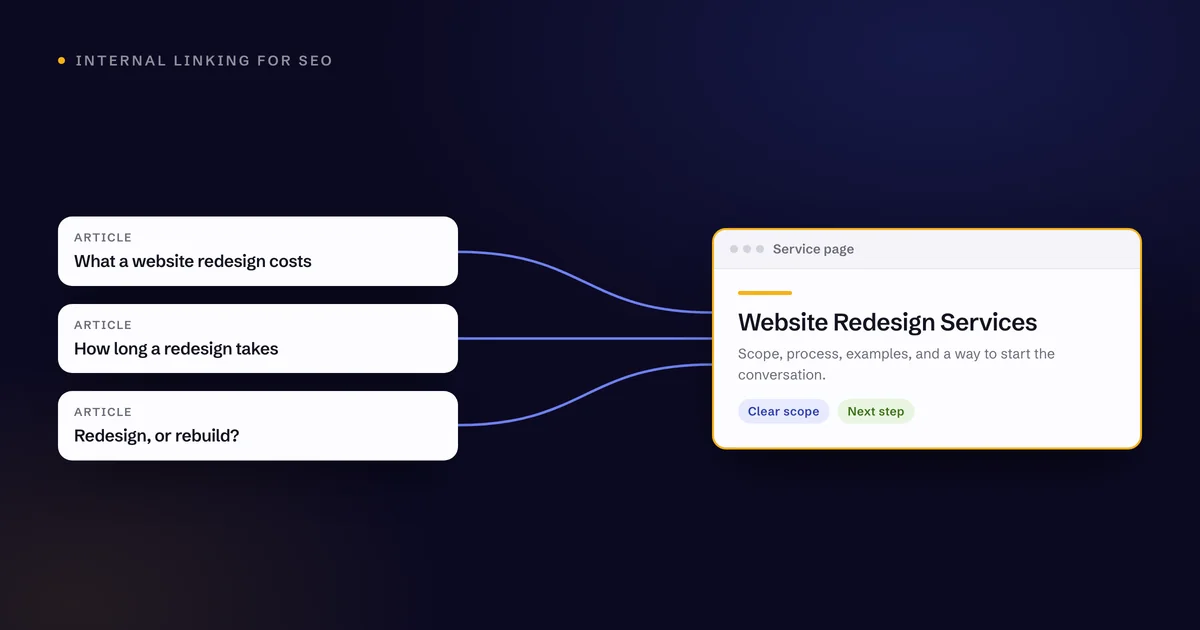
One article might cover cost. Another might explain the project timeline. A third could help someone decide whether to redesign or rebuild.
Those pages can support the same service without repeating each other. The connection should make sense even if search engines did not exist.
Measure what happens after the click
Record the pages you changed, the links you added, and the business action you want to improve.
Then watch relevant impressions, clicks, and inquiries over the following weeks. Compare similar periods and account for seasonal demand or other website changes.
Rankings are useful feedback. A qualified lead is closer to the reason you did the work.
You may not need a bigger content calendar yet. You may need to make the content you already paid for easier to find, easier to follow, and more useful. The same work tends to make your business easier to research wherever that research happens.
Sources for this article
Want a second set of eyes on your website? Let's look at the gaps between getting discovered and earning the inquiry.
Start a conversation